
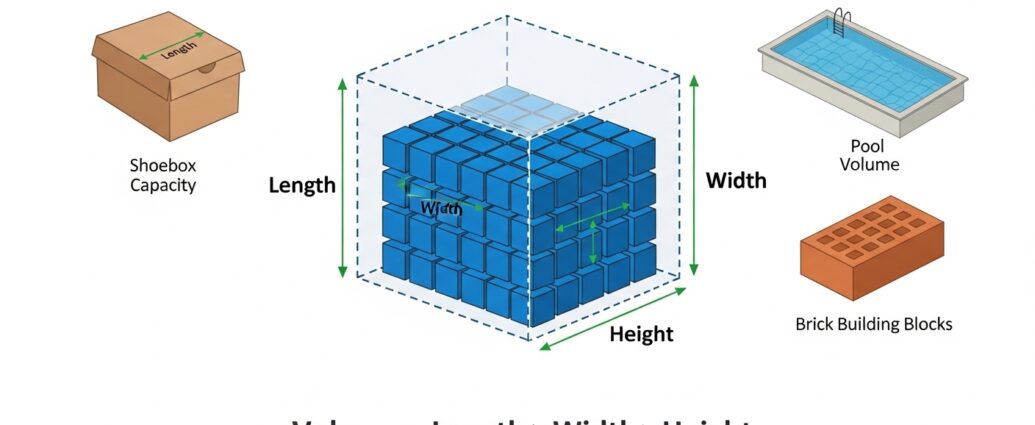
Mathematics plays an essential role in helping people understand the shape and space of objects around them. One important concept in geometry is the volume of cuboid, which measures how much space a three dimensional rectangular object occupies. Many everyday items such as boxes, rooms, containers, and storage units share the shape of a cuboid. Learning how to calculate this volume helps students, engineers, designers, and architects make accurate measurements in practical situations. By understanding the structure of a cuboid and how its dimensions work together, anyone can easily determine its volume and apply this knowledge in both academic learning and real world problem solving.
What a Cuboid Is in Geometry
A cuboid is a three dimensional geometric shape that has six rectangular faces, twelve edges, and eight vertices. Each pair of opposite faces in a cuboid is equal and parallel, which gives the shape a balanced rectangular structure. Common examples include bricks, books, storage boxes, and shipping containers. In geometry, the dimensions of a cuboid are described as length, width, and height. These three measurements determine the total space inside the object. Understanding the structure of this shape is essential before calculating the volume of cuboid because the formula relies directly on these three dimensions working together to represent spatial measurement accurately.
Understanding the Concept of Volume
Volume refers to the amount of three dimensional space that an object occupies. In geometry, measuring volume helps determine the capacity of containers or the internal space within solid objects. When discussing the volume of cuboid, the measurement represents how much space exists inside its rectangular boundaries. This concept is particularly useful when dealing with storage planning, packaging design, or construction calculations. Unlike area, which measures two dimensional surfaces, volume measures depth as well. By combining length, width, and height, the volume of cuboid provides a complete understanding of the space contained within the shape.
The Formula for Volume of Cuboid
The formula used to calculate the volume of cuboid is simple and widely taught in mathematics education. It is found by multiplying the length, width, and height of the cuboid together. These three measurements represent the three dimensions that define the shape. When multiplied, they determine the total internal space of the cuboid. The result is usually expressed in cubic units such as cubic meters, cubic centimeters, or cubic feet depending on the measurement system used. Understanding this formula helps students solve many geometry problems efficiently and also forms the foundation for calculating volumes of other three dimensional shapes in mathematics.
Importance of Dimensions in Calculating Volume
The accuracy of the volume of cuboid calculation depends entirely on the correct measurement of its three dimensions. Length represents the longest side of the cuboid, width measures the side across the base, and height shows how tall the object stands vertically. Each of these dimensions contributes equally to determining the total internal space. If one measurement is incorrect, the final volume result will also be inaccurate. This is why precise measurement tools are often used in engineering, construction, and manufacturing. Understanding the relationship between these dimensions helps learners visualize how the volume of cuboid expands or decreases depending on size.
Real Life Examples of Cuboids
Many objects used in daily life have the shape of a cuboid, which makes the concept of volume of cuboid extremely practical. Shipping boxes, refrigerators, cabinets, books, and storage containers all follow a rectangular structure similar to a cuboid. Calculating their volume helps determine how much material they can store or how much space they require. In logistics and packaging industries, understanding this measurement is essential for organizing goods efficiently. Even room measurements in buildings often resemble cuboid shapes. These real life examples demonstrate how geometry connects directly with everyday tasks and professional applications across many fields.
Units Used to Measure Volume
When calculating the volume of cuboid, the result must always be expressed in cubic units. A cubic unit represents a cube with equal length, width, and height. Common units include cubic centimeters, cubic meters, and cubic inches depending on the measurement system used. The choice of unit depends on the size of the cuboid being measured. Small objects such as boxes or containers often use cubic centimeters, while larger structures like rooms or warehouses use cubic meters. Using correct units ensures clarity and accuracy when communicating measurements. This consistency is important in scientific calculations, engineering designs, and educational mathematics.
Applications in Construction and Engineering
The volume of cuboid plays a significant role in construction and engineering projects. Builders frequently calculate the volume of spaces such as rooms, storage areas, and building foundations. Engineers also rely on cuboid measurements when designing equipment, packaging structures, or transportation containers. Accurate volume calculations help determine how much material is needed for construction or how efficiently space can be used. These calculations also assist in planning ventilation systems, storage arrangements, and building layouts. Because many structural elements resemble cuboid shapes, understanding this geometric concept allows professionals to create designs that maximize both efficiency and functionality.
Learning the Volume of Cuboid in Education
Students are introduced to the concept of volume of cuboid early in their mathematics education because it builds foundational understanding of three dimensional geometry. Teachers often use visual models such as boxes or blocks to demonstrate how length, width, and height combine to create space. This hands on learning approach helps students grasp the idea of volume more easily. By practicing calculations with real measurements, learners develop problem solving skills and mathematical confidence. Mastering this concept also prepares students for more advanced topics in geometry, physics, architecture, and engineering where spatial reasoning becomes increasingly important.
Common Mistakes When Calculating Volume
While the formula for the volume of cuboid is straightforward, mistakes can occur when measurements are not handled carefully. One common error involves confusing units of measurement, which can lead to incorrect results. Another mistake occurs when students accidentally use area formulas instead of volume calculations. Some learners also forget to ensure that all dimensions are measured in the same unit before multiplying them. Attention to detail is essential when performing geometric calculations. By checking measurements and understanding the formula clearly, students and professionals can avoid errors and produce accurate results when determining the volume of cuboid.
Conclusion
The concept of volume of cuboid is one of the most practical ideas in geometry because it connects mathematical theory with real world applications. By understanding the shape of a cuboid and learning how to multiply its three dimensions, anyone can determine the amount of space contained within a rectangular object. This knowledge is valuable in education, engineering, architecture, logistics, and many everyday activities. From calculating storage capacity to designing buildings, the ability to measure volume accurately plays an important role in modern life. Mastering the volume of cuboid provides a strong foundation for understanding three dimensional space and practical measurement.